
21 September 2026
Singapore’s small- and mid-cap (SMID) equities are becoming increasingly investable as liquidity, research coverage and institutional participation improve. Supported by initiatives such as EQDP, market conditions are strengthening beyond the largest index constituents.
While large caps have led recent gains, many SMIDs continue to trade at relatively appealing valuations, creating opportunities for selective, actively managed investors.
Singapore’s small- and mid-cap (SMIDs) equity segment is entering a more constructive phase. Historically, limited trading liquidity and sparse research coverage restricted institutional participation and weakened price discovery in the market cap spectrum. The rollout of the Equity Market Development Programme (EQDP) directly addresses these constraints by broadening the pool of active fund management capital, extending investor attention beyond the largest index constituents and strengthening the supporting research ecosystem.
This development reinforces the structural case for Singapore equities, highlighting the market’s resilient economic base, defensive characteristics and policy support, while positioning SMIDs as one of five investment themes associated with EQDP. We believe the opportunity arises from the transition underway: market quality is improving, but liquidity, research coverage and price discovery remain uneven. These conditions may allow fundamental investors to identify high-quality companies before broader institutional participation narrows information and valuation gaps.
Many large-cap stocks in Singapore have rallied in recent years. While SMIDs have delivered solid performance, they continue to lag their larger peers. The resulting performance and valuation divergence suggests that the next phase of market broadening could extend to smaller companies as liquidity and visibility improve. However, the segment should not be approached as a uniform allocation. Differences in business quality, governance, balance-sheet resilience and trading depth remain substantial, placing stock selection and portfolio construction with prudent risk management at the centre of the investment case.
Trading liquidity and research coverage have historically represented the principal barriers to institutional ownership of Singapore SMIDs. These constraints are mutually reinforcing: limited turnover reduces the capacity of larger investors to build positions, while a narrow ownership base weakens the commercial incentive for research coverage and issuer engagement. Nevertheless, we have been witnessing gradually improving trends across these conditions.
The number of SGX-listed companies trading above the S$1 million average daily trading value threshold has increased in recent years, with the most notable improvement among SMIDs (chart 1). Investibility is determined not only by market capitalisation, but also by the ability to establish and adjust positions without materially affecting market prices. The broadening in liquid names therefore enlarges the practical opportunity set available to active managers and reduces reliance on a concentrated group of large cap index constituents.
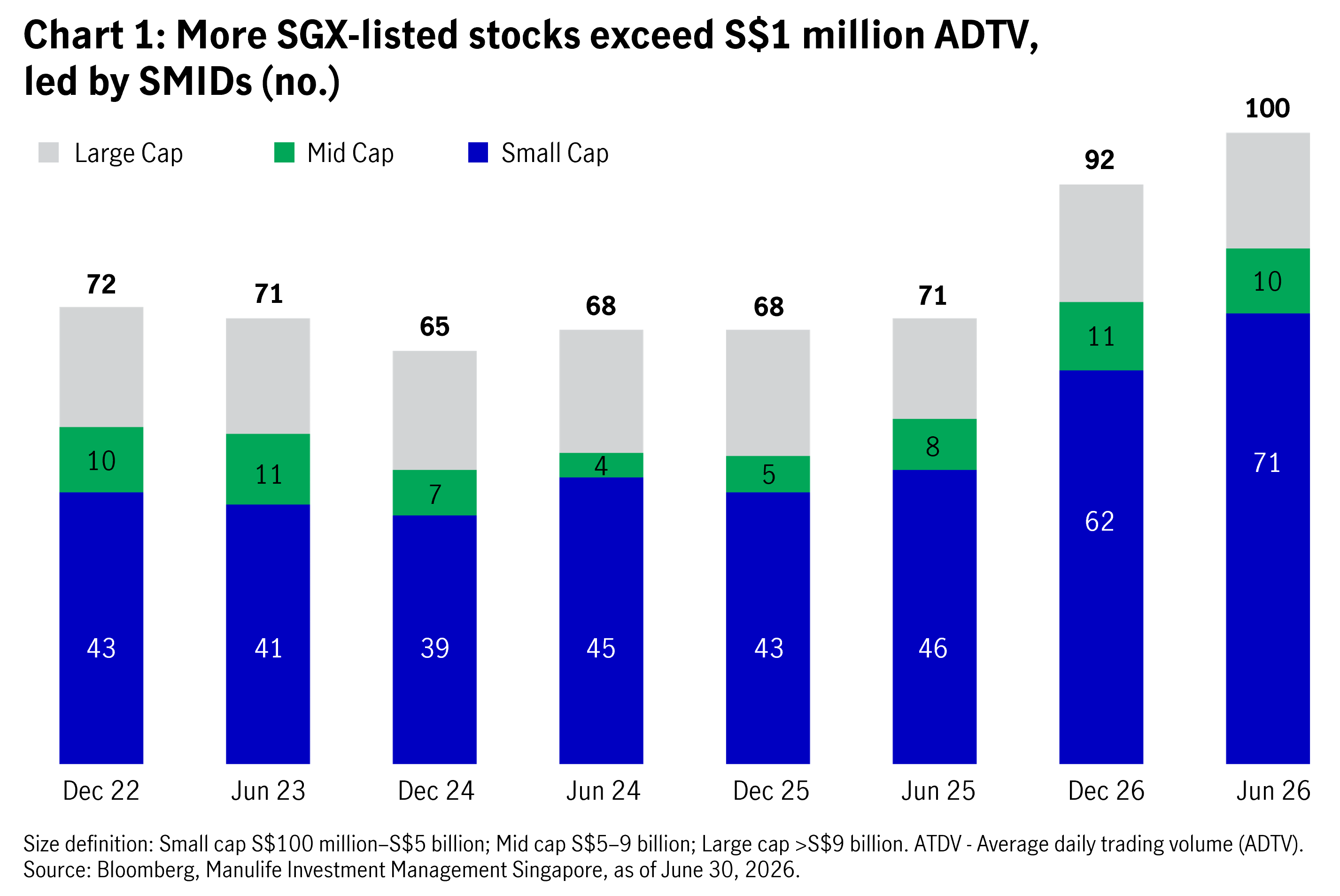
The implications extend beyond an increase in turnover. More consistent trading depth can support more efficient execution, more reliable valuation signals and greater confidence in position scalability.
It may also encourage more regular issuer engagement, as a broader shareholder base increases the value of disclosure and capital-market communication. EQDP is therefore relevant as an ecosystem catalyst: sustained active participation can reinforce liquidity and price discovery over time, rather than producing only a temporary increase in activity.
More SGX-listed companies are receiving active sell-side research coverage, improving the availability and comparability of financial information (chart 2). This is particularly relevant for SMIDs, where historically limited external coverage has often delayed market recognition of operational improvement, balance-sheet strength or better capital allocation.
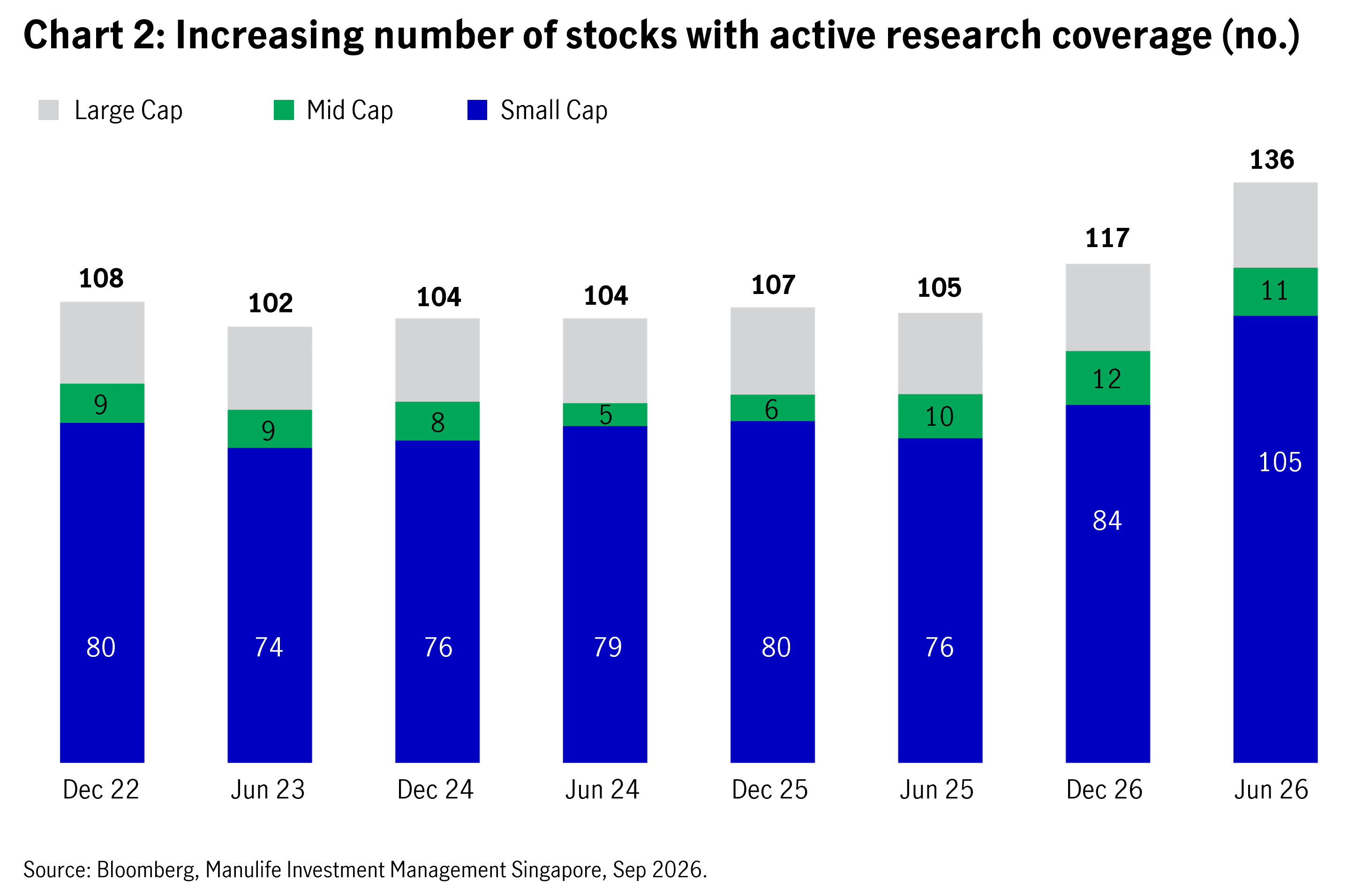
The Grant for Equity Market Singapore (GEMS) research scheme complements this process by directly addressing one of the structural gaps in Singapore equities: the limited commercial incentive to initiate and maintain coverage on smaller companies. The scheme was introduced by Monetary Authority of Singapore (MAS) to strengthen Singapore’s equity capital market, including support for research talent development and research initiatives that enhance coverage of Singapore-listed companies, particularly in the SMIDs segment. In its enhanced form, the programme also supports research on pre-initial public offering (IPO), IPO and post-IPO companies, helping to widen the information funnel before and after listing. This can improve the continuity of analyst attention, issuer engagement and investor education around companies that may otherwise remain outside the regular coverage universe.
Improved coverage should enhance price discovery, but it may also reduce the duration of mispricing. The current environment consequently represents an attractive transition period: information remains uneven, while the mechanisms that can bring under-researched companies into wider investor focus are strengthening. Fundamental research remains essential to identify earnings inflections, changes in cash conversion, balance-sheet optionality and capital-allocation catalysts before they become fully reflected in market expectations. Additional coverage in itself is not a re-rating catalyst; underlying companies must still deliver solid earnings, credible governance and shareholder returns. Its importance lies in improving the transmission between fundamental progress and market recognition, particularly for companies that have historically remained outside the regular scope of institutional research.
The broadening of Singapore’s equity market should be evident not only in trading liquidity and research coverage, but also in how active investors allocate capital. The expectation of greater institutional participation should reinforce the improvements in liquidity and research coverage discussed above. As more funds build meaningful positions in SMIDs, companies may benefit from a wider shareholder base, more regular investor engagement and stronger market feedback on disclosure, governance and capital allocation. Over time, this may support more effective price discovery and a more differentiated valuation framework across the segment.
The impact, however, is unlikely to be uniform. Incremental active capital is likely to favour companies with sufficient liquidity, visible earnings growth, sound governance and credible capital-allocation discipline. Greater buy-side attention should therefore sharpen the distinction between investible SMIDs and persistent value traps, reinforcing the importance of deep fundamental research even as the broader market backdrop becomes more supportive.
Our strategy is positioned to participate in this broadening through an all-cap approach with dynamic allocation as our strategy can allocate meaningfully to SMIDs when the risk-return profile is attractive, with a target SMID allocation of around 60%, while retaining the flexibility to pivot back into large caps when defensiveness, liquidity or income resilience becomes more important, with a target large-cap allocation of around 40%. Position sizing is therefore driven by bottom-up stock selection and portfolio construction rather than by index weights alone. This is particularly relevant in Singapore, where the benchmark remains concentrated in a narrow set of large caps and may not fully capture the emerging opportunity in higher-quality SMIDs.
A more active initial public offering market is an important component of a sustainable equity-market ecosystem. New listings provide growth capital to companies, broaden the sector composition of the exchange and expand the opportunity set beyond established index constituents. As secondary-market liquidity and institutional participation improve, Singapore should also become a more attractive listing venue, supporting a more continuous pipeline of investible companies.
Nonetheless, a larger opportunity set does not automatically translate into stronger investment outcomes (chart 3). Among the 16 SGX Mainboard IPOs since 2025, the wide dispersion between the strongest and weakest 30-day returns shows that average performance masks materially different company-level results. New issuance should therefore be viewed as a stock-selection opportunity rather than a broad market exposure.
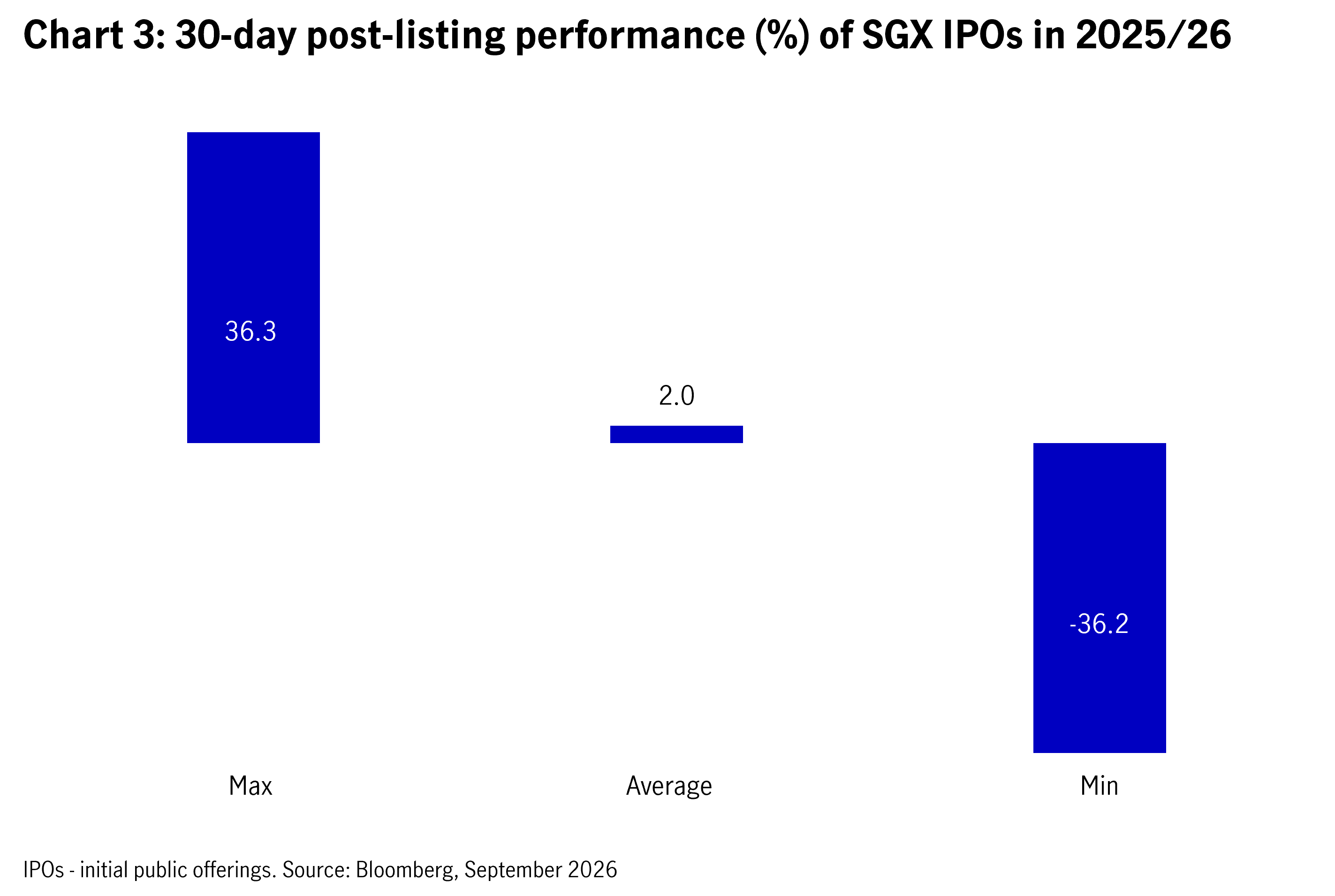
We approached the IPO opportunity set selectively, applying the same growth, cash flow, management and valuation (GCMV) and catalyst framework used for seasoned issuers. We assess new listings based on growth durability, management quality, cash-flow and balance-sheet resilience, valuation discipline and the presence of company-specific catalysts. While a stronger IPO pipeline expands the investible universe, we believe active stock selection remains the primary determinant of investment outcomes.
Singapore equities have also seen a widening divergence (chart 4).
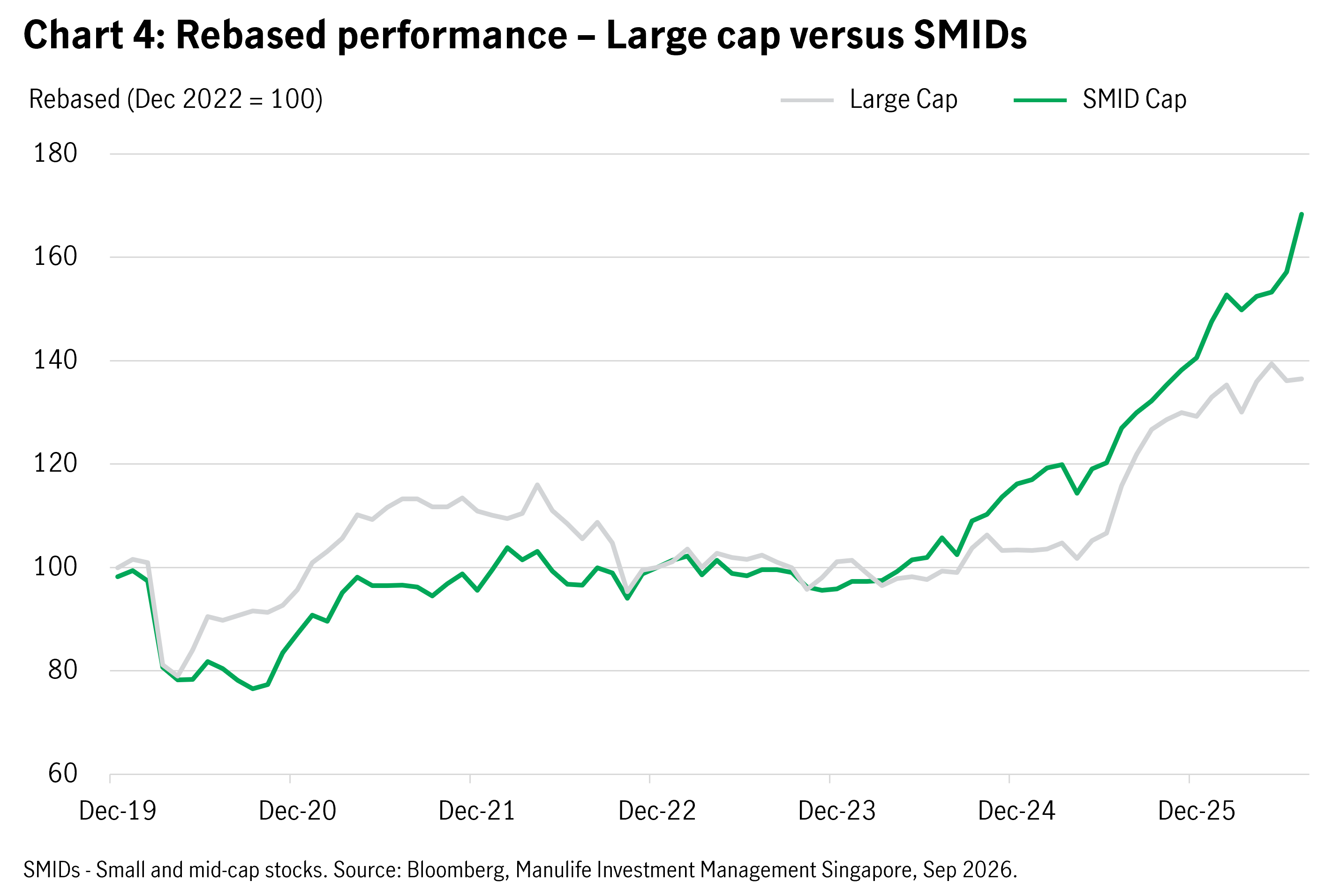
Large caps have delivered a strong rally over the past three years, while SMIDs have lagged despite improving market conditions. As EQDP supports broader liquidity, research coverage and institutional participation, the catch-up opportunity may increasingly shift toward higher-quality SMIDs that have yet to be fully reflected in market valuations.
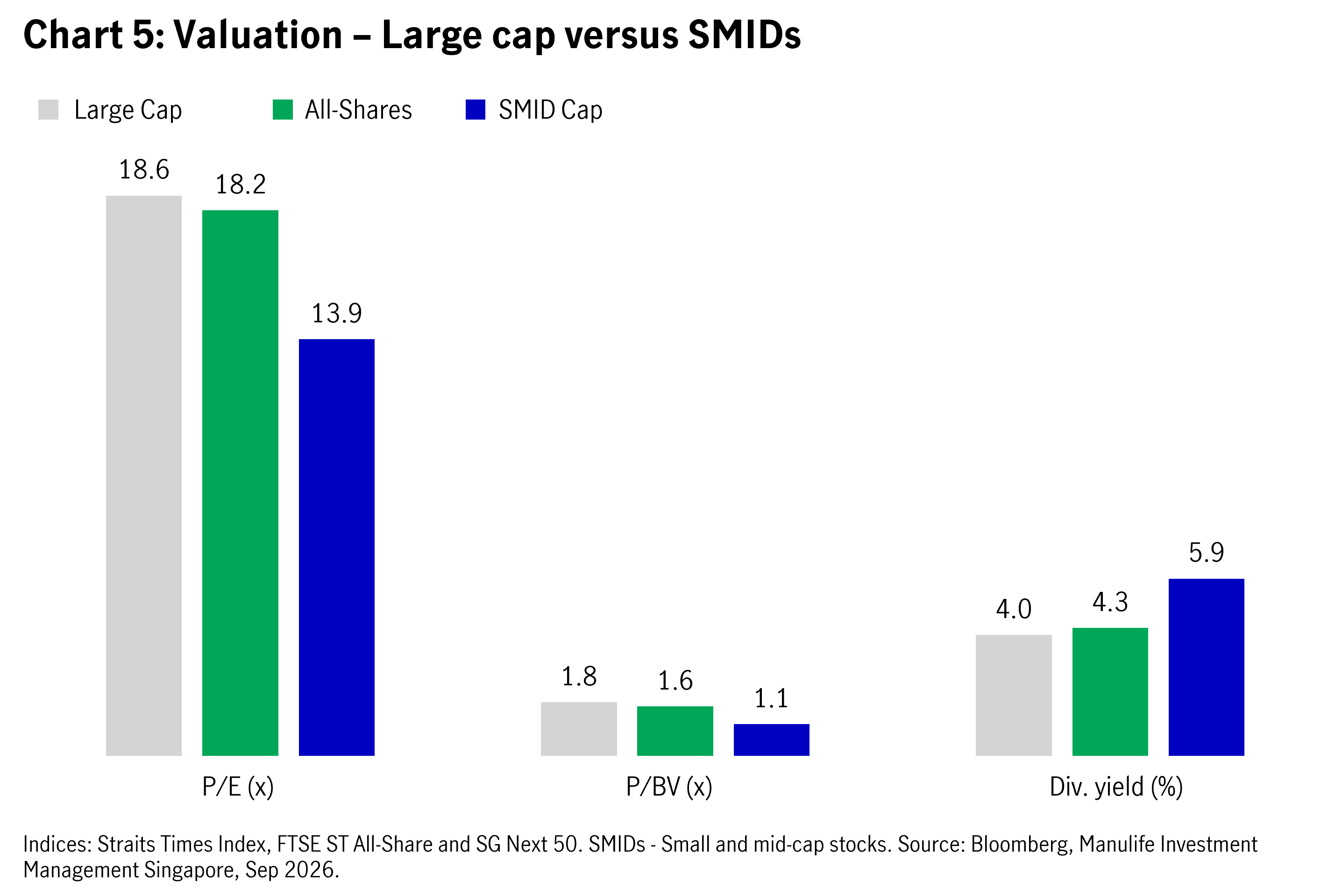
In terms of valuation, SMIDs are trading at more attractive valuation metrics, with lower price-to-earnings and price-to-book multiples, as well as higher dividend yields, as compared to large caps (chart 5). This may provide a more favourable entry point for investors seeking companies with resilient earnings, sound balance sheets and credible shareholder-return policies.
Singapore SMIDs are becoming a more compelling opportunity as market infrastructure around the segment continues to improve. Better liquidity, broader research coverage and rising institutional participation should support more effective price discovery and create a stronger foundation for selected smaller companies to narrow the performance gap with large caps.
On the other hand, the opportunity set should be approached with selectivity. An expanding investible universe, improving research ecosystem and stronger IPO pipeline can help bring more companies into market focus, but dispersion in business quality, governance, liquidity and balance-sheet resilience warrant caution from investors. Active management is therefore critical to identify companies with sustainable earnings growth, disciplined capital allocation and credible shareholder-return policies, while avoiding those whose low valuations reflect structural weaknesses.
We believe fund managers with rigorous investment processes, deep local market experience and robust risk management capabilities are well positioned to deliver alpha in this space. An all-cap framework may provide the flexibility to allocate meaningfully to SMIDs when company-level risk-reward is appealing, while retaining exposure to large-cap liquidity and defensiveness when market conditions warrant. This combination of fundamental selectivity, portfolio flexibility and disciplined risk control is essential to unlocking the opportunity in Singapore SMIDs.
Asia High Yield has reached new highs; what’s next?
Asia High Yield (HY) bonds, known for providing an attractive source of income, present a very different opportunity set today compared to the pre-pandemic era. As discussed in our investment note from nearly a year ago, the asset class is no longer dominated by Chinese Mainland property developers. Instead, it has become more diversified, with investment opportunities spanning multiple areas, such as financial institutions, gaming operators, infrastructure providers, and selected frontier markets.
Global Equity Diversified Income (GEDI) Fund: Staying selective through market volatility
Global equity markets have recently experienced greater volatility. Much of this has been driven by earnings announcements from AI hardware, semiconductor and large cloud-computing companies. Concerns about potential interest rate hikes have also added to investor uncertainty. After a prolonged period of strong performance in AI-related areas, market expectations have become demanding. Even companies reporting solid results have experienced sharp share-price moves when their outlook has only met, rather than exceeded, investor expectations. Against this backdrop, the GEDI Fund remains focused on its core objective: generating income while maintaining diversified exposure to potential capital growth.
Global Multi Asset Diversified Income Strategy (GMADI) update: A balanced approach to market volatility
Global equity markets have recently experienced sharper movements, particularly in areas linked to artificial intelligence (AI). Earnings announcements from AI hardware, semiconductor and large cloud-computing companies have been key sources of volatility. Concerns about potential interest rate hikes have added to uncertainty. The Global Multi Asset Diversified Income (GMADI) Strategy has not been immune to these market movements. However, its income focus, broad diversification and relatively defensive positioning may help limit the effect of sharp changes in technology and growth-related investments.
Asia High Yield has reached new highs; what’s next?
Asia High Yield (HY) bonds, known for providing an attractive source of income, present a very different opportunity set today compared to the pre-pandemic era. As discussed in our investment note from nearly a year ago, the asset class is no longer dominated by Chinese Mainland property developers. Instead, it has become more diversified, with investment opportunities spanning multiple areas, such as financial institutions, gaming operators, infrastructure providers, and selected frontier markets.
Global Equity Diversified Income (GEDI) Fund: Staying selective through market volatility
Global equity markets have recently experienced greater volatility. Much of this has been driven by earnings announcements from AI hardware, semiconductor and large cloud-computing companies. Concerns about potential interest rate hikes have also added to investor uncertainty. After a prolonged period of strong performance in AI-related areas, market expectations have become demanding. Even companies reporting solid results have experienced sharp share-price moves when their outlook has only met, rather than exceeded, investor expectations. Against this backdrop, the GEDI Fund remains focused on its core objective: generating income while maintaining diversified exposure to potential capital growth.
Global Multi Asset Diversified Income Strategy (GMADI) update: A balanced approach to market volatility
Global equity markets have recently experienced sharper movements, particularly in areas linked to artificial intelligence (AI). Earnings announcements from AI hardware, semiconductor and large cloud-computing companies have been key sources of volatility. Concerns about potential interest rate hikes have added to uncertainty. The Global Multi Asset Diversified Income (GMADI) Strategy has not been immune to these market movements. However, its income focus, broad diversification and relatively defensive positioning may help limit the effect of sharp changes in technology and growth-related investments.



